The Pantheon Itinerary
Mary's Trip Journal: Rome, Italy
When I saw the Pantheon in person, it immediately shifted from a picture in a textbook to something I could physically marvel at. What stood out the most to me was how its purpose has evolved without losing its relevance throughout history.
It was originally built as a temple for all of the Roman gods, reflecting the authority and inclusivity of Roman religion. Later, when it transformed into a Christian church, it helped preserve it and gave it a new spiritual identity. It continued to function as a place of worship instead of becoming deserted.
When I stood beneath the oculus, I was struck by how the open space seemed to form a bond between the human and the divine. It highlighted a shared human experience despite multiple shifts in religious function. I also learned that the Pantheon serves as a burial site for important figures like the artist Raphael, adding another massive layer to its role in Roman cultural life.
Experiencing the Pantheon in person made me realize it is not just a historical landmark. It is a welcoming space that has been modified to meet the cultural and spiritual needs of society over time while still keeping the core pieces of its origin.


Walking Ancient Rome Site
Mary's Trip Journal: Rome, Italy
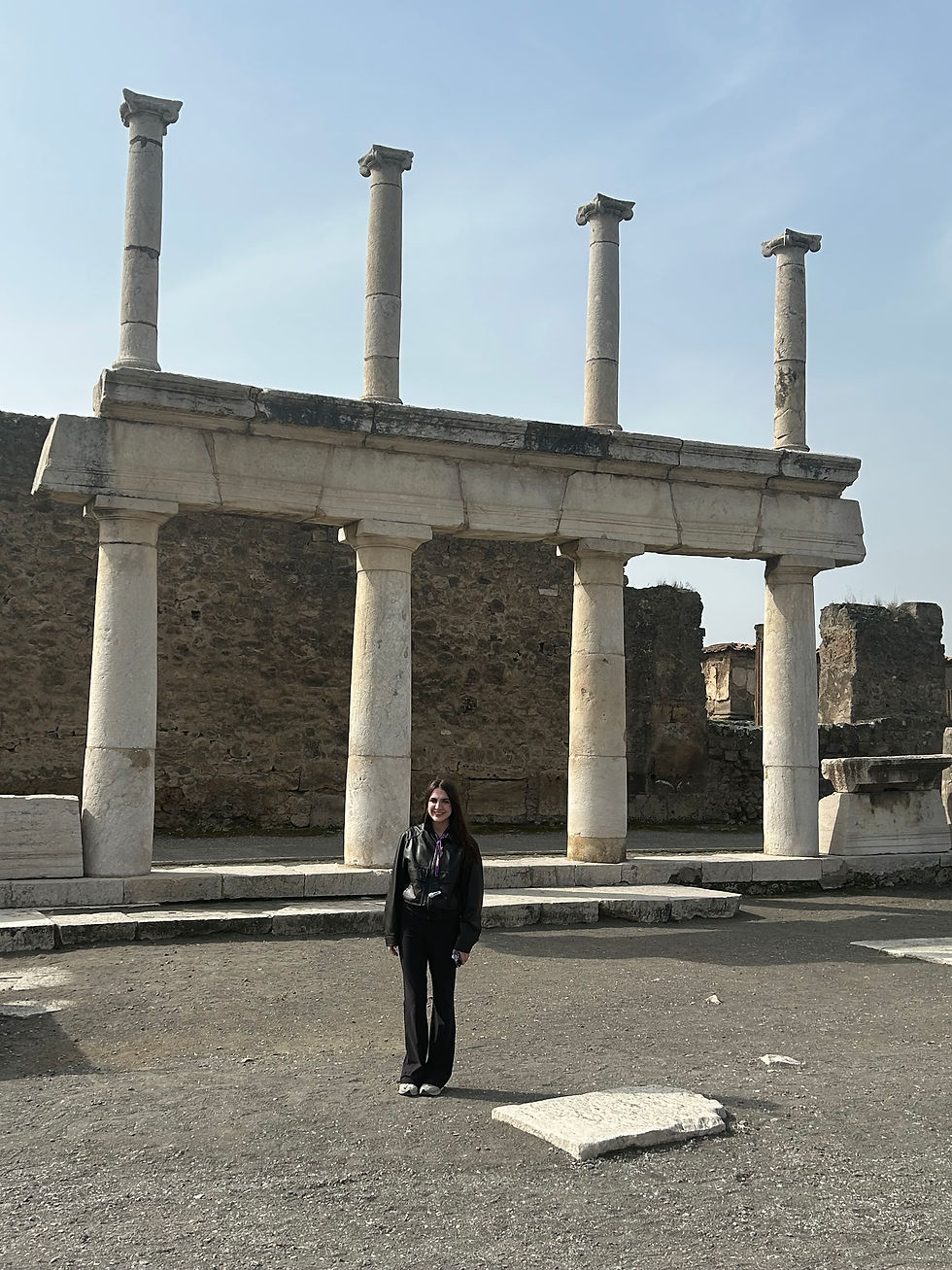
Exploring the Roman Forum offered me a direct connection to the pulse of ancient civilization within a single valley. These storied ruins, from majestic crumbling temples to the remnants of senate houses, reveal the architectural footprint of a once-mighty social hub. It was here that Roman citizens gathered to debate policy, conduct commerce, and perform sacred rituals that defined their empire. Navigating the weathered stones allowed me to grasp the magnitude of life as it unfolded centuries ago. This archaeological park serves as a profound testament to the enduring legacy of civic space and the immense political authority Rome exerted throughout history. Even in its current state of decay, the Forum commands respect for the innovation it represents.


The Colosseum Itinerary
Mary's Trip Journal: Rome, Italy

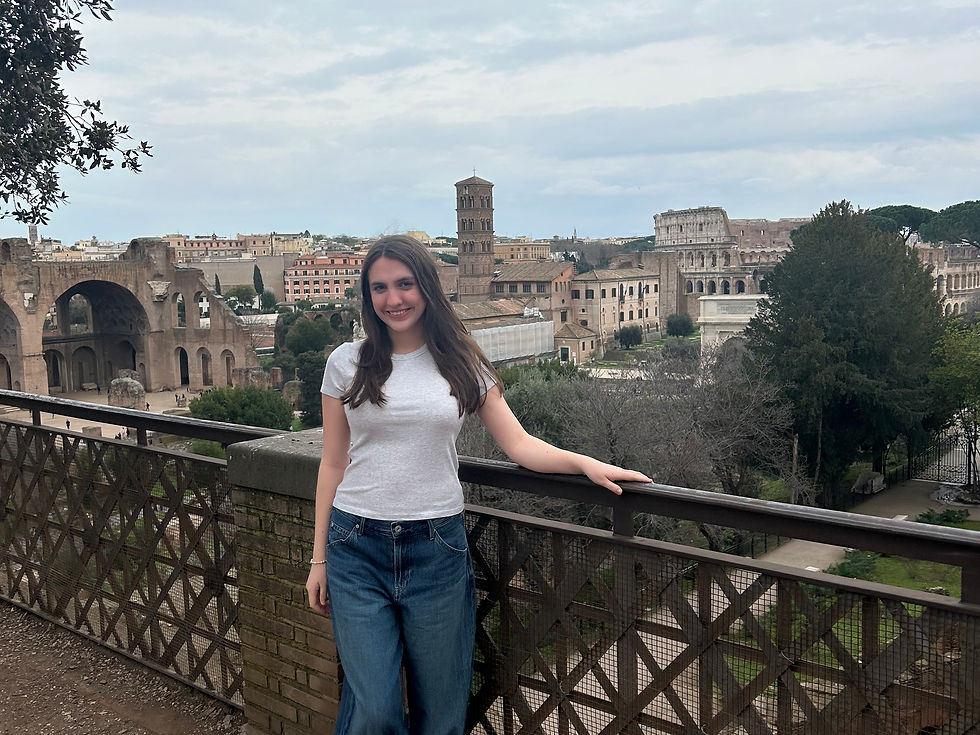
My visit to the Colosseum was one of the highlights of my trip. Seeing the massive amphitheater up close helped me understand why it is one of the most recognizable symbols of ancient Rome. When I stood inside the arena I tried to picture what it must have been like when thousands of spectators filled the seats watching the events below.
One surprising thing I learned during the tour was that many gladiators were not Roman citizens. Many came from conquered areas of the empire and were trained to fight. Becoming a gladiator often meant signing a contract that required years of service before a fighter could gain freedom.
Even though the games were dangerous I learned that most gladiators survived their fights. Since they were expsensive to train owners tried to protect their fighters. Still their lives were incredibly tough. Gladiators trained hard and sometimes wore heavy animal skins during practice to get ready for combat in the arena.
The events at the Colosseum also included animal hunts. Animals from all over the empire were brought into the arena and I learned that they were sometimes starved beforehand to make them more aggressive during the shows. Hearing this helped me grasp how brutal some of these events must have been.
Another detail that fascinated me was the engineering of the Colosseum. The stadium had a retractable roof system called a velarium which could be extended to provide shade for spectators. Learning about this made me realize how advanced Roman engineering was nearly two thousand years ago.
The Colosseum was originally built under the Roman emperor Vespasian and completed by his son Titus in 80 AD. Later the empire began to change when Constantine the Great helped establish Christianity as a major religion in the Roman world.
Visiting the Colosseum helped me see that it was more than just an arena for entertainment. It reflected the values, power, and culture of the Roman Empire. For me, the experience turned the Colosseum from something I had only seen in pictures into a place that felt real and historically alive.

Pompeii Itinerary
Mary's Trip Journal: Pompei, Italy
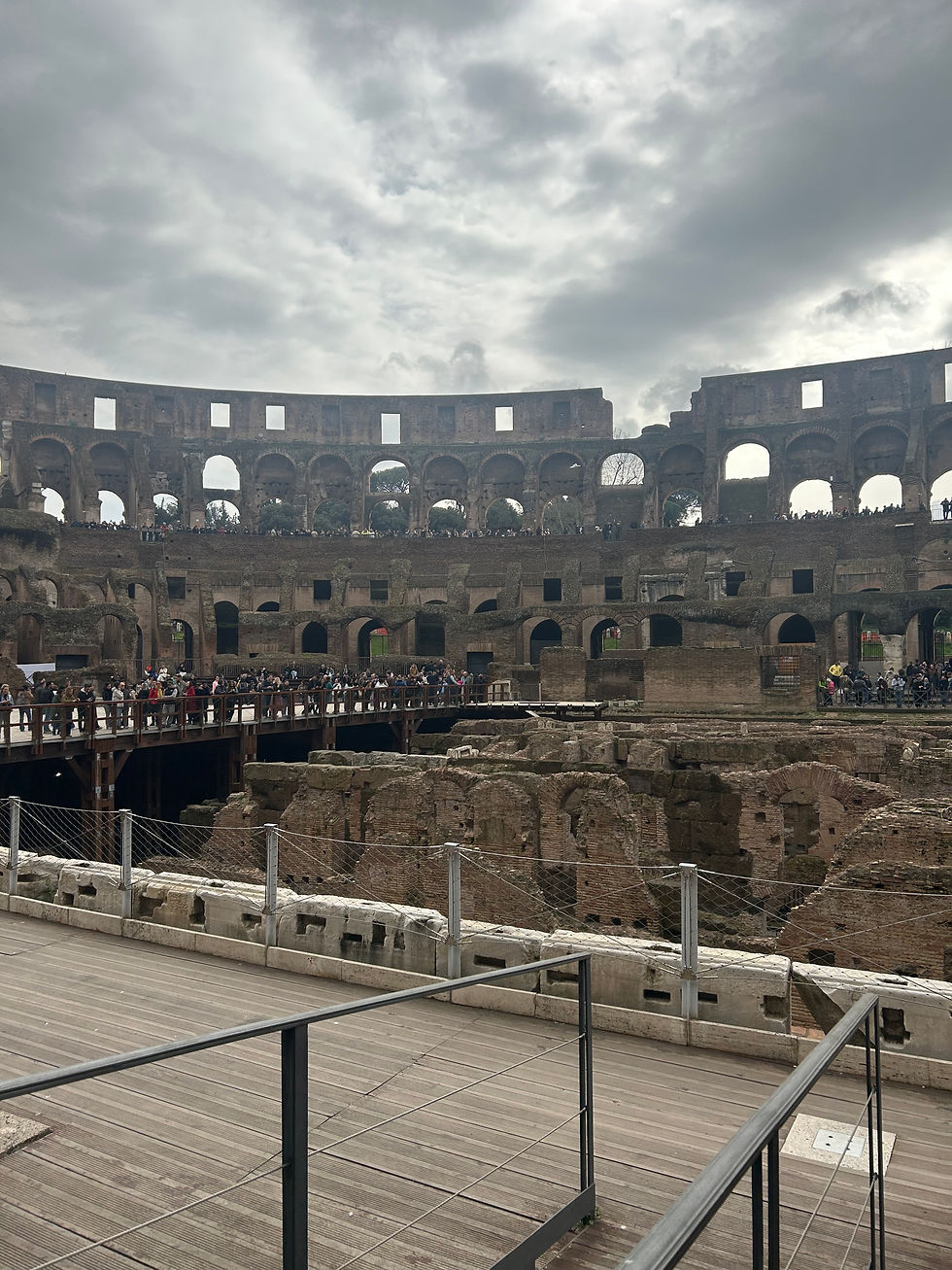
Visiting the ruins of Pompeii was a different experience from seeing monuments like the Colosseum. Instead of standing in a single large structure, I walked through an entire ancient city. Streets, houses, shops, and public spaces were still visible, making it easier to picture daily life nearly two thousand years ago. Pompeii was famously destroyed in 79 AD when Mount Vesuvius erupted and buried the city in ash. Though the eruption was devastating, it preserved much of the city's layout and architecture. Because of this, archaeologists have learned a lot about how ancient Romans lived.
As I walked along the streets, I noticed how carefully the city was designed. Large cobblestone stepping stones were placed across the roads, allowing people to cross without stepping in waste or water flowing through the streets. Some areas of the pavement even had small marble fragments embedded in the stone. These pieces of marble would reflect moonlight at night, helping to light up the streets.
The houses in Pompeii revealed interesting details about Roman life. Many homes had an open space in the center designed to collect rainwater. Rain would fall through a roof opening and drain into a basin below, which families could use for everyday needs. Bedrooms in these houses, called cubiculum, showed that Roman architecture even had specific names for each type of room.
Walking past the shops was another fascinating part of the city. Some entrances still showed carved lines in the ground, likely marking where doors or shutters closed when the shop was not open. Small details like these help picture the city when it was active and full of people. One of the most surprising symbols I saw throughout Pompeii was the image of a phallus carved into walls or stone. While this may seem strange today, it held important meanings in Roman culture. The symbol represented fertility and was believed to protect against evil. In some cases, it even directed visitors to brothels in the city.
Pompeii was also closely linked to the Roman goddess Venus, viewed as the city's patron deity. Her presence in temples and artwork throughout Pompeii shows how religion was closely tied to daily life in the ancient world.
Walking through Pompeii made history feel incredibly real. Instead of imagining ancient Rome in abstract terms, I could see the streets people walked on, the homes they lived in, and the businesses they ran. The city may have been frozen in time by a disaster, but it now offers one of the clearest views into everyday life in the ancient Roman world.